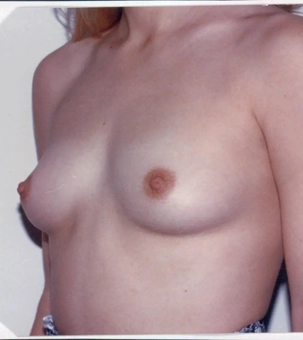
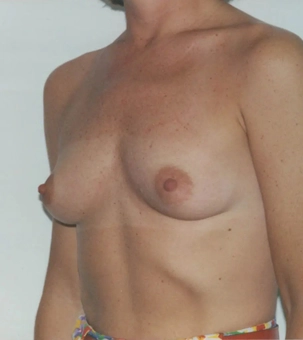
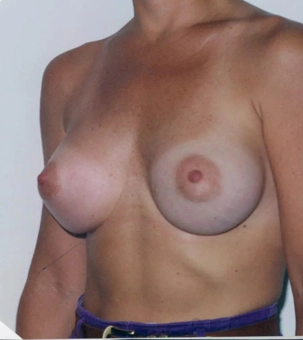
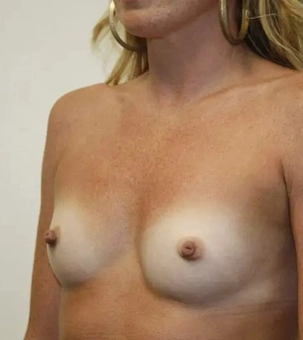
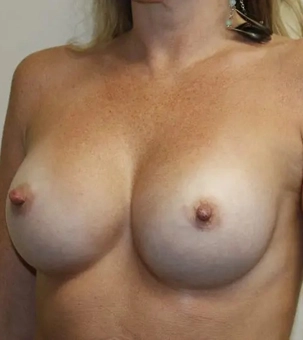
Breast implants are available in both round and anatomical (or “teardrop”) shapes. Round implants are among the most popular options because they create enhanced fullness throughout the upper portion of the breast and can provide a softer, more youthful appearance.
Anatomical implants are designed to mimic the natural slope of breast tissue and may be preferred by patients seeking a more subtle enhancement; some shaped implants are highly cohesive, form-stable silicone devices commonly called gummy bear implants, which help retain their shape even if the shell breaks. If Dr. Ackerman discusses textured implants during consultation, he may explain that they are sometimes used with certain anatomical devices to help limit rotation.
Choosing the correct implant size is one of the most important aspects of breast augmentation planning.
Rather than focusing solely on cup size, Dr. Ackerman evaluates chest dimensions, natural breast tissue, skin elasticity, and body proportions to recommend implant sizes that create balanced, harmonious results.
Implants may be placed either above or below the chest muscles. Submuscular placement, which places the implant beneath the muscle, often creates a softer, more natural transition along the upper breast.
The dual-plane (subpectoral) approach places the implant partially beneath the pectoralis muscle, resulting in a natural-looking breast contour. Subglandular placement, located above the muscle, may be appropriate for certain patients seeking enhanced projection or who already have sufficient natural breast tissue coverage. The subfascial approach places the implant above the muscle but beneath the fascial layer, which can reduce animation deformities and support faster recovery time.
For reference, a 2022 study from the American Society of Plastic Surgeons showed that submascular placement was highly favored, with an increase of 22% to 56% from 2005 to 2020.2
The incision location will depend on certain factors, such as implant size, breast aesthetics, and implant placement.
You should evaluate before-and-after photos to assess the quality of a surgeon’s incision techniques before your surgery. As always, Dr. Ackerman will discuss which approach will best suit your needs.